A cryptocurrency exchange app is mainly a place to buy and sell crypto. A mobile wallet is mainly a tool for accessing crypto and authorizing transactions. They can look almost identical on a phone, but the difference matters when you withdraw funds, lose your device or need to recover access.
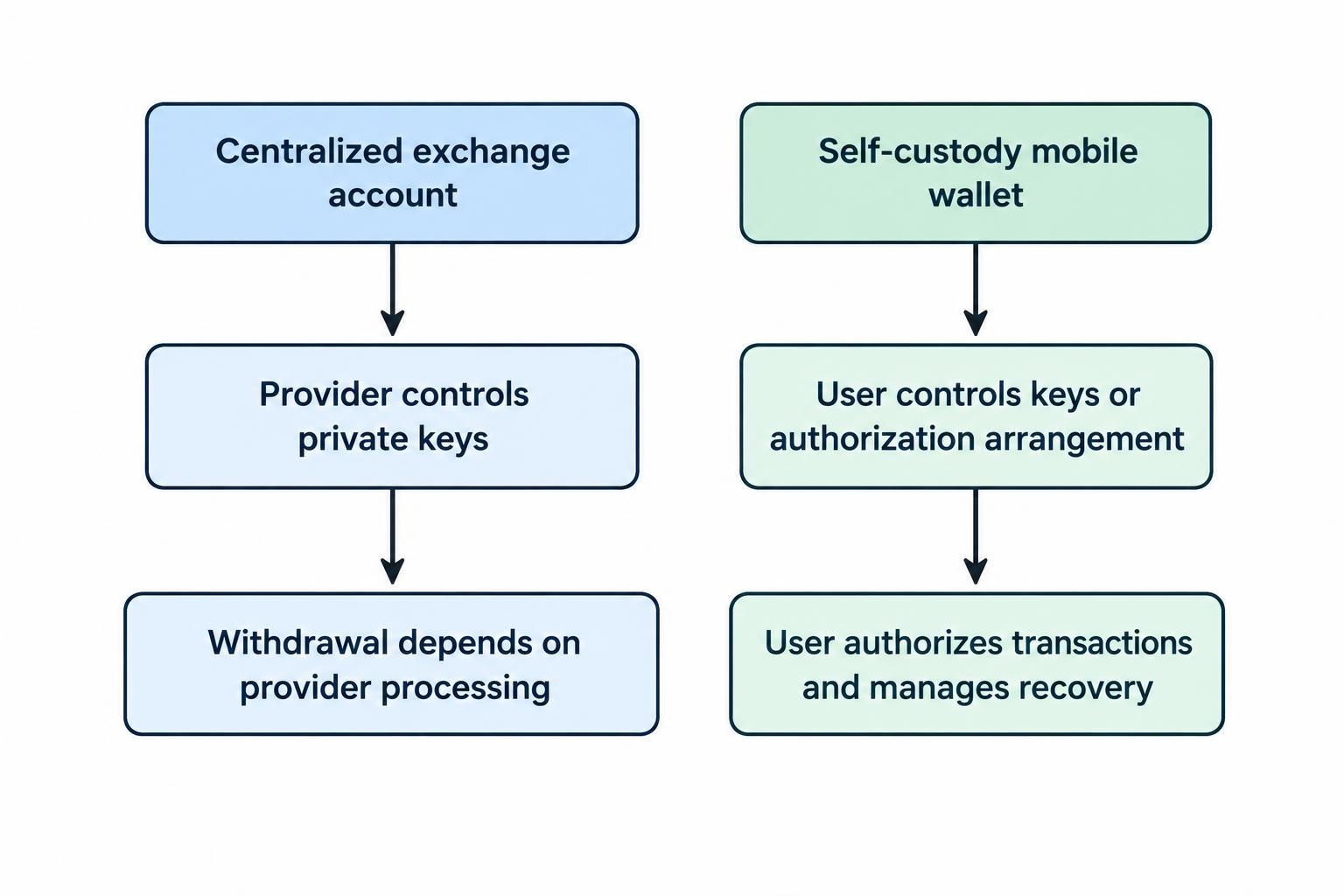
The central question is custody: who controls the private keys that authorize transactions? In a typical centralized exchange account, the provider controls those keys. With a self custody mobile wallet, you take responsibility for them. Neither arrangement removes the risk of losing money; it changes which risks you carry.
This comparison focuses on exchange accounts that hold actual cryptocurrency and mobile wallets that let you control it. A trading app offering only price exposure through derivatives is a different product, not a substitute for a wallet.
Exchange Apps vs Mobile Wallets: The Main Differences
“Exchange” describes a trading service. “Wallet” describes a way to access and transact with crypto. These categories overlap: an exchange can provide a custodial wallet, and a self custody wallet can include buying and swapping features. Judge the arrangement, not the label on the app store.
| Feature | Typical centralized exchange app | Typical self custody mobile wallet |
|---|---|---|
| Private key control | The exchange or its custodian controls the keys. | You control the keys or the wallet’s authorization arrangement. |
| Main purpose | Buying, selling and managing exchange orders. | Receiving, sending and using crypto on supported networks. |
| Access recovery | Usually involves the provider’s account recovery process. | Depends on your backup and the wallet’s recovery design. |
| Moving funds | Requires the provider to process a withdrawal. | You authorize a transaction, subject to network rules. |
| Main custody risk | Provider failure, withdrawal restrictions or account compromise. | Lost recovery information, stolen keys or harmful approvals. |
Crypto does not sit inside an app like cash in a pocket. Ownership and balances are recorded through the relevant blockchain system; wallets manage the credentials used to access them. The SEC investor bulletin on crypto custody sets out the distinction between self custody and third party custody.
What an Exchange App Does Well
An exchange app can provide a convenient workflow for funding an account, placing trades and converting sale proceeds back into cash, where those services are available. Before choosing one, check the assets, payment methods and withdrawal facilities offered to customers in your location.
For an active trader, assess the trading screen rather than the promotional home screen. Can you see the spread, enter an order accurately, review open orders and confirm whether an order filled? A polished balance chart is not much help if the order ticket hides the fee.
Also establish whether the service supports external crypto withdrawals. A displayed bitcoin balance does not, by itself, prove you can transfer bitcoin to a wallet you control. Check the withdrawal terms for the exact asset and network before depositing money.
The wider mobile cryptocurrency trading guide covers the trading side. For this comparison, the relevant distinction is simpler: trading access and independent control over crypto are separate capabilities.
An Account Balance Is Not a Completed Withdrawal
A purchase displayed in your exchange account should not be treated as evidence that crypto has reached your personal wallet. That requires a separate withdrawal to the correct destination.
When reviewing an exchange, check withdrawal minimums, processing conditions, security holds and supported networks. Ask what happens if withdrawals are suspended. Do not build a time sensitive payment or trading plan around an untested withdrawal route.
What a Self Custody Mobile Wallet Does Differently
A self custody wallet lets you authorize transactions without asking an exchange to release an account balance. That control is useful for receiving crypto directly, making transfers and interacting with supported blockchain applications.
It also changes the support relationship. A wallet developer may help troubleshoot an interface or explain a backup process, but that is not the same as having authority to restore missing keys or reverse a transaction. A support ticket is not a spare key.
Before funding a wallet, establish how recovery works. Many wallets use a recovery phrase, but do not assume every product follows the same design. Read the documentation for the actual wallet you intend to use, including any optional recovery services and their dependencies.
A Phone Wallet Is Not Automatically Cold Storage
A wallet that holds signing keys on an internet connected phone is generally a hot wallet. Self custody does not automatically mean offline storage.
A hardware wallet can keep signing keys on a separate device, with a phone used to prepare and broadcast transactions where supported. This can reduce exposure of the keys, but it does not make every transaction safe. You still need to check what you authorize. Bitcoin.org’s wallet security guidance covers backups, offline signing and separating everyday spending funds from savings.
For a larger holding, consider whether the convenience of keeping everything immediately accessible on your phone justifies the exposure. There is no universal balance threshold. The amount you can afford to lose, your transaction needs and your ability to maintain backups should drive that decision.
Compare the Full Cost, Not Just the Trading Fee
Downloading an app for free tells you very little about its operating cost. Compare the complete route you expect to use: cash deposit, crypto purchase, withdrawal, wallet transaction and eventual sale.
For an exchange, inspect trading commissions, the quoted buying and selling prices, payment charges and withdrawal fees. For a wallet, inspect network fees and any charges from integrated purchase or swap services. Check which company provides each service and which terms apply.
A wallet’s “buy” button deserves particular attention. It may open a purchase service with different pricing and identity checks from the wallet itself. Compare the amount of crypto you will receive after charges, not just the headline fee percentage.
Network costs also matter after withdrawal. On Ethereum mainnet, sending tokens generally requires ETH for transaction fees. Having a token balance does not necessarily mean you have the asset needed to move it. The Ethereum wallet transaction guide covers fee funding and the need to match the recipient’s network.
Use realistic transaction sizes when comparing costs. A fixed withdrawal charge affects a small transfer much more heavily than a large one. Avoid unnecessary transfers, but do not leave more with a provider than you are comfortable exposing simply to save a fee.
Security: Different Risks, Not a Risk Free Winner
Exchange Custody Creates Provider Dependence
With an exchange account, evaluate both account security and the provider relationship. Review the legal entity serving you, its custody terms, withdrawal policy and any insurance exclusions. Do not treat a recognizable brand or an app store listing as a financial guarantee.
For US users, cryptocurrency is not covered by FDIC deposit insurance. A provider’s relationship with an insured bank does not turn its crypto balances into insured deposits. The FDIC advisory on crypto companies and deposit insurance addresses this distinction.
Keep the questions separate: what protects account access, what happens if the provider fails, and what losses does any advertised insurance actually cover? An answer to one does not settle the others.
Self Custody Makes Authorization Your Responsibility
With a mobile wallet, protect more than the app login. In a phrase based wallet, someone who obtains the recovery phrase may be able to access the assets without unlocking your phone. Do not send it to support agents, paste it into a chat or enter it into an unsolicited “verification” page.
Blockchain applications introduce another decision: what permission are you granting? Some token approvals authorize a contract to spend tokens. Review the amount and purpose rather than approving every prompt to reach the next screen. Ethereum’s security guidance addresses recovery phrase theft, transaction checks and token spending permissions.
Device protection remains part of either setup. Use a strong screen lock, keep software updated and secure the email account attached to your exchange. The separate guide to mobile trading app security covers those controls without confusing them with custody.
What Happens If You Lose Your Phone?
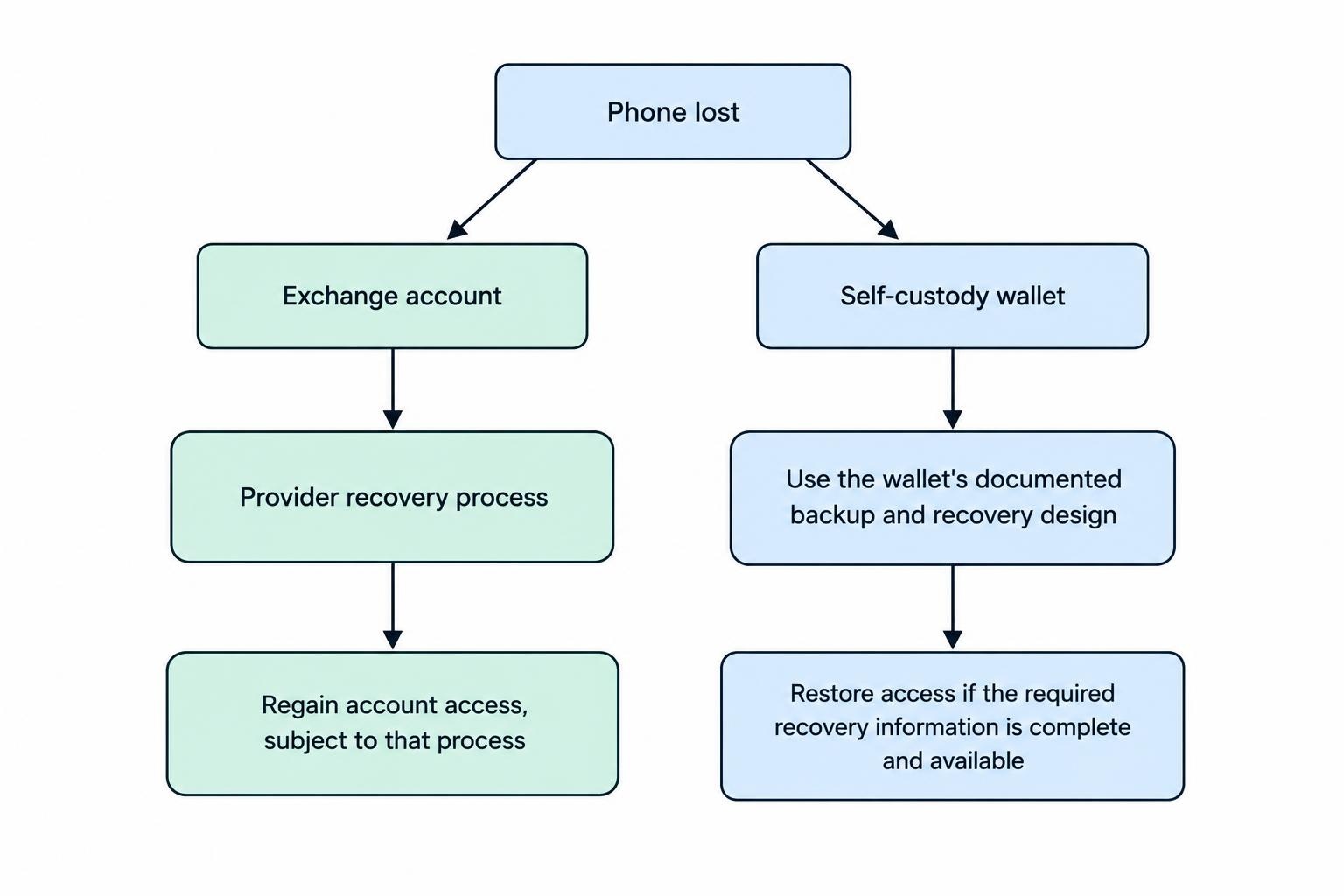
For an exchange account, prepare for the provider’s recovery process before you need it. Check how you would regain access without your phone, email app or usual authentication method. Keep recovery materials protected somewhere other than the device they are meant to replace.
For a self custody wallet, follow its documented backup process before transferring a meaningful amount. Record what you need to restore access, including any separately configured passphrase. A backup is useful only if it is complete, readable and available when needed.
Use a low value setup to become familiar with recovery. Do not experiment with your only working copy of an important wallet, and do not delete a functioning wallet just to see whether you can restore it.
Losing a phone and losing the ability to authorize transactions are not necessarily the same event. The practical test is whether you retain a secure, working recovery route that does not depend entirely on that phone.
How to Transfer Crypto Between an Exchange and a Wallet
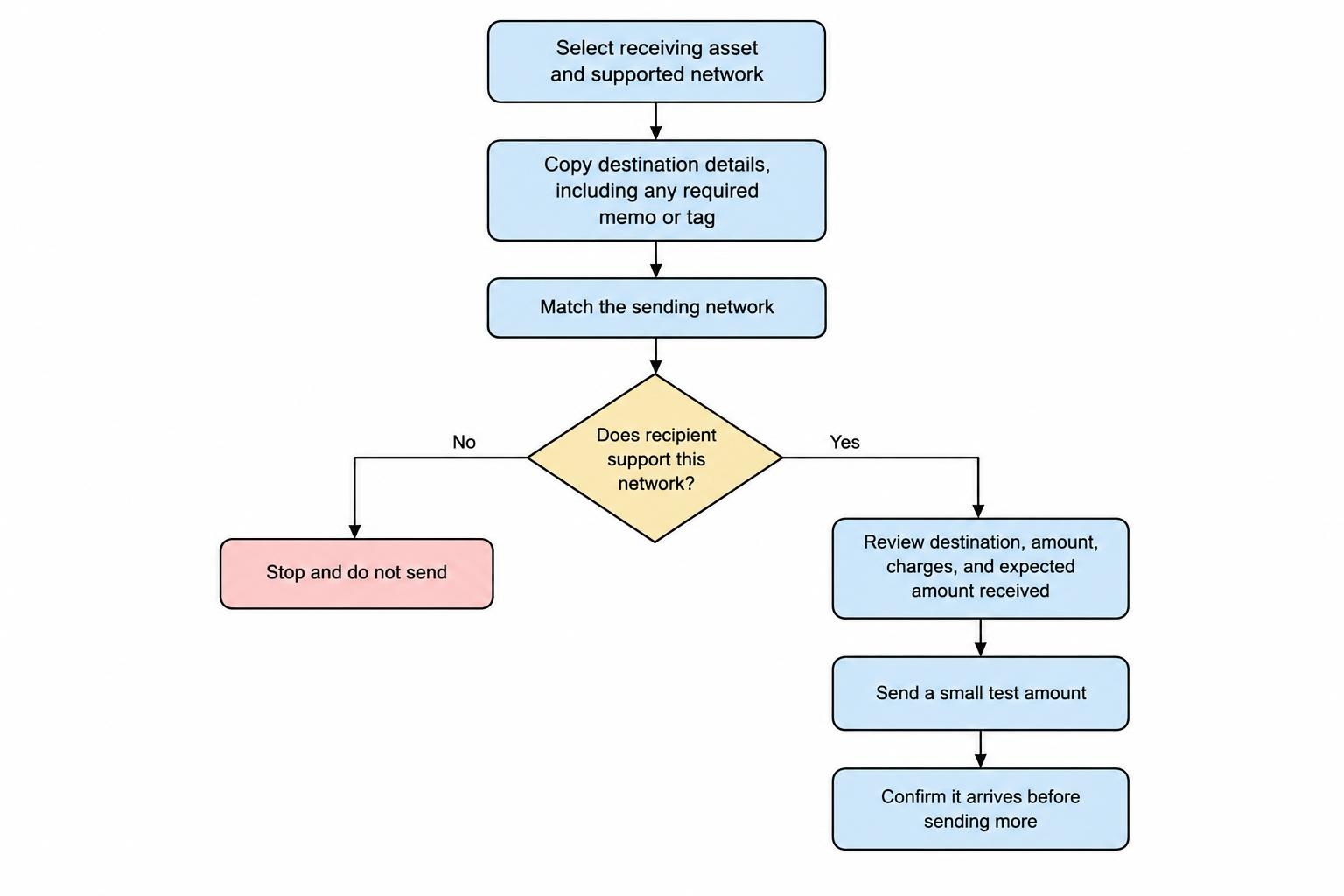
Treat the first transfer as a verification exercise, not a race. A correct token name is only part of the check: the asset, network and destination requirements must all agree.
- Open the receiving service. Select the asset and supported deposit or receiving network.
- Copy the destination details. Include any required memo or destination tag. Do not type a long address manually.
- Match the sending network. Do not select a cheaper network unless the recipient supports it for that asset.
- Review the final screen. Check the destination, amount, charges and expected amount received.
- Send a small test amount. Keep it above applicable minimums and confirm it arrives before sending more.
A successful test does not remove the need to check the next transfer. Verify the destination again rather than assuming a saved address or copied value is correct.
Distinguish “requested,” “broadcast” and “credited” when checking progress. If an exchange supplies a transaction identifier, use it to inspect the network transaction. Do not submit a duplicate transfer simply because the receiving app has not refreshed.
Crypto payments generally cannot be reversed like a disputed card payment. Public blockchains can also expose transaction details, so self custody should not be confused with anonymity. The FTC guidance on cryptocurrency payments covers both payment finality and public transaction records.
Which Setup Fits Your Use?
For frequent exchange trading, assess whether a custodial account meets your execution and withdrawal needs. Decide in advance how much capital you are willing to leave there, rather than allowing the balance to grow without reviewing the custody risk.
For direct payments or blockchain applications, assess a self custody wallet’s network support, transaction display and recovery process. Start with an amount small enough that a mistake will not damage your finances.
Using both can separate trading funds from funds intended for direct use or longer holding. It also creates more accounts, backups and transfer steps to manage. More tools do not automatically mean better security.
Before committing money, make sure you can answer four questions: who authorizes transfers, how you recover access, what the full transaction costs are, and what could prevent a withdrawal. Choose the arrangement whose responsibilities you can actually manage, not the one with the most reassuring padlock icon.