Mobile cryptocurrency trading means buying, selling and managing crypto positions through a smartphone or tablet. The app provides access; the trading venue, product and custody arrangement determine what you actually own, how orders execute and whether you can withdraw your assets.
A convenient interface can hide those differences. Buying bitcoin on a spot exchange is not the same transaction as opening a leveraged bitcoin contract, even if both screens display a price chart and a large Buy button. Before placing an order, establish what the product is, what the full transaction costs and how you will manage it when your phone is unavailable.
This guide covers the decisions that matter for mobile crypto trading: market access, trading pairs, execution, fees, position risk and account security.
How Mobile Crypto Trading Works
A trading app connects your account to a service that accepts orders and maintains your balances. On an order book exchange, buy and sell orders meet at available prices. A simpler purchase screen may instead present a quote for the amount you want to trade. Check which method you are using rather than assuming every screen offers the same price.
Cryptocurrency spot markets generally trade around the clock, including weekends. That creates access outside conventional market hours, but also exposure while you sleep. CME Group’s research on continuous cryptocurrency trading examines the persistence of weekend price movements. An individual platform can still interrupt access for maintenance or other operational reasons.
Build your routine around periods when you can make deliberate decisions. Continuous trading is not an instruction to watch your phone continuously. If a position requires constant attention to remain manageable, reconsider its size or whether it belongs in your account at all.
Know Which Crypto Product You Are Trading
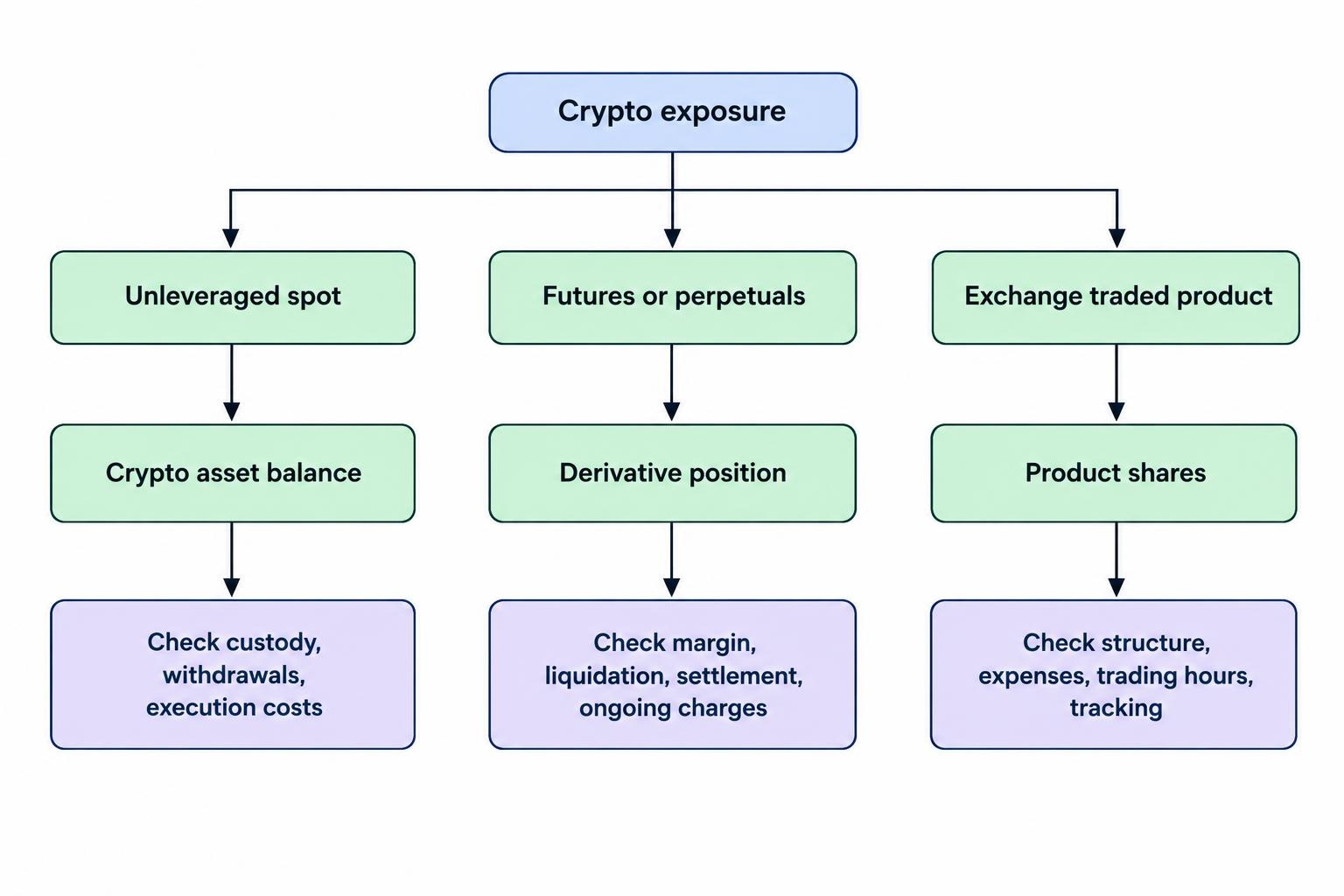
Start with the product label and account agreement, not the ticker symbol. Different routes to cryptocurrency exposure create different ownership rights and risks.
| Product | What you hold | What to check |
|---|---|---|
| Unleveraged spot crypto | A crypto asset balance under the platform’s custody terms, or assets controlled through your own wallet | Withdrawal support, custody arrangements and execution costs |
| Crypto futures or perpetual contracts | A derivative position rather than necessarily owning the underlying coins | Margin, liquidation rules, settlement and ongoing charges |
| Crypto exchange traded products | Shares in a product providing cryptocurrency exposure | Product structure, expenses, trading hours and tracking differences |
Availability depends on your location and the provider’s permissions. Do not assume that a product offered elsewhere is available to a US retail customer, or that access through an app establishes permission to use it.
Borrowed exposure deserves particular caution. A price move against a leveraged position can consume the deposited margin much faster than the same move would reduce an unleveraged holding. Some futures positions can lose more than the initial investment, as covered in the CFTC advisory on virtual currency trading risks.
For a first mobile trading workflow, unleveraged spot trading removes margin and liquidation calculations from the order process. It does not remove market losses, platform failure or theft.
Read Trading Pairs Before Reading the Chart
A crypto pair states what you are buying and what you are paying with. In BTC/USD, bitcoin is the base asset and US dollars are the quote currency. A displayed price of $80,000 means one bitcoin costs $80,000 before transaction costs. Buying $400 worth would therefore purchase 0.005 BTC before fees.
BTC/USDC is different. You pay with USDC rather than a bank dollar balance. BTC/ETH introduces another comparison: bitcoin’s value relative to ether. A gain measured in the quote asset does not necessarily mean a gain measured in dollars.
Stablecoins aim to maintain a reference value, but that target is not a guarantee of the market price. The Federal Reserve research on stablecoin markets examines how issuance, redemption and secondary market trading affect their prices during stress.
Before trading, confirm the pair, settlement asset and balance the app will debit. Also check whether the quantity field expects coins or a currency amount. Entering “500” into the wrong field is not a trading strategy, however confidently the button lights up.
Choose an App by Its Controls, Not Its Coin Count
Compare the functions you will actually need: clear order previews, readable balances, reliable transaction history, accessible support and an understandable fee schedule. A long asset menu offers little value if you cannot check an order’s status without searching through several screens.
Custody deserves the same attention. With third party custody, another organisation controls the private keys used to authorise transactions. With self custody, that responsibility rests with you. Losing access credentials or recovery material can have permanent consequences; the SEC investor bulletin on crypto asset custody covers the distinction and questions to ask a custodian.
Check the legal entity serving your account, not just the brand displayed in the app store. Read the terms covering asset ownership, withdrawals and what happens if the provider stops operating. An attractive balance display does not answer any of those questions.
For a closer comparison of these access models, see cryptocurrency exchange apps versus mobile wallets. The practical decision is whether you need an execution service, control over assets, or separate tools for each task.
Calculate the Full Cost of a Mobile Crypto Trade
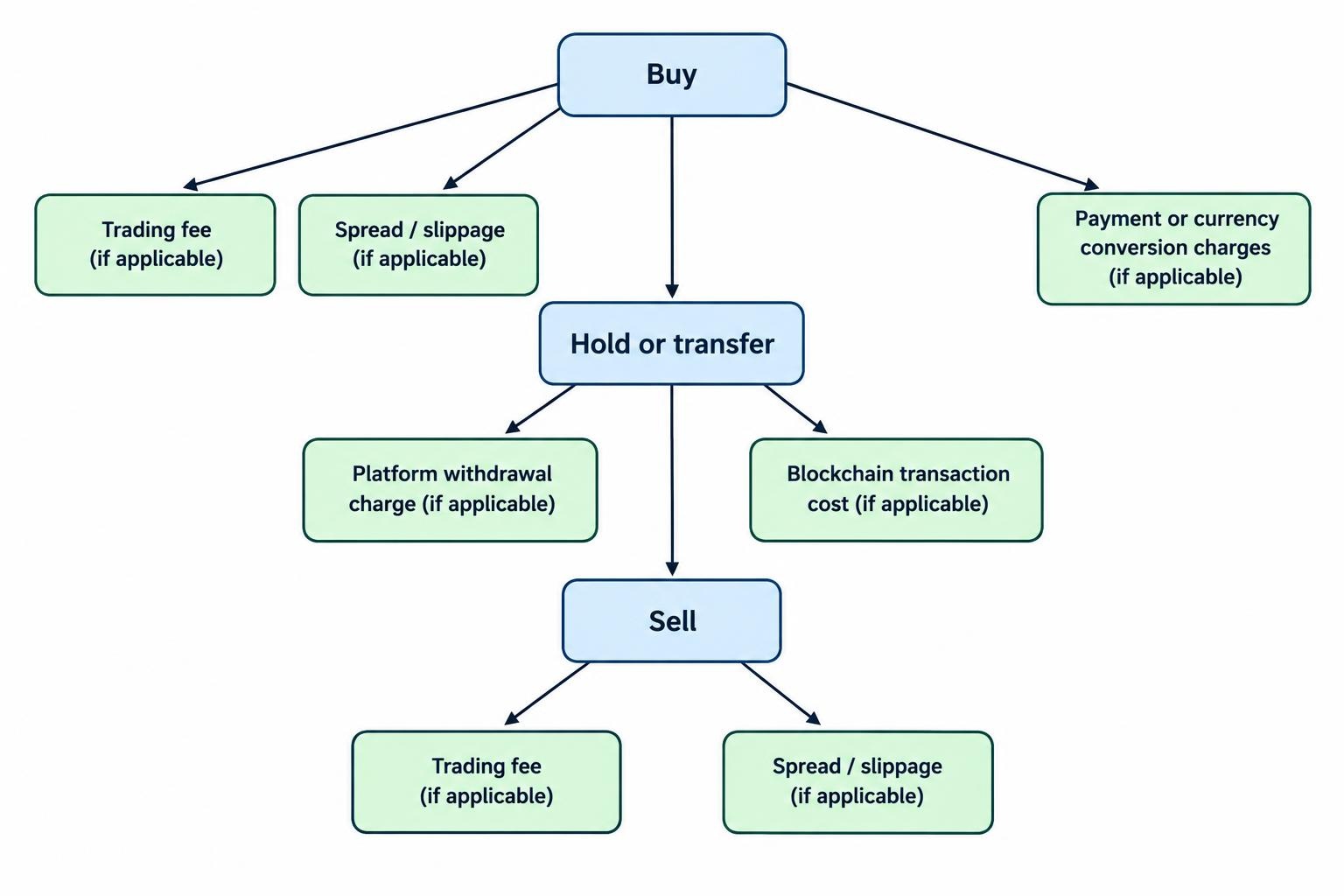
The trading fee is only part of the cost. Compare the amount you spend with the amount of cryptocurrency you receive, then consider what selling and withdrawing would cost.
On an order book, the spread is the gap between the best available buying and selling prices. Slippage is the difference between the expected execution price and the price actually obtained. A market order that consumes available liquidity at several price levels can produce an average fill different from the price visible when you tapped.
Other charges can include payment processing, currency conversion and withdrawals. Blockchain transaction costs and platform withdrawal charges are not necessarily the same thing. Read the withdrawal preview rather than assuming a displayed network fee represents the entire charge.
Consider a hypothetical $1,000 purchase with a 0.4% trading fee. The entry fee is $4. If you later sell approximately $1,000 at the same fee rate, that adds roughly another $4. Spread, slippage and any transfer charges sit outside this simplified calculation.
A small intended profit can disappear before the market moves against you. Compare complete transaction paths, not a single advertised rate. The broader guide to mobile trading fees and costs covers how to assess these charges across an account.
Place Orders Carefully on a Small Screen
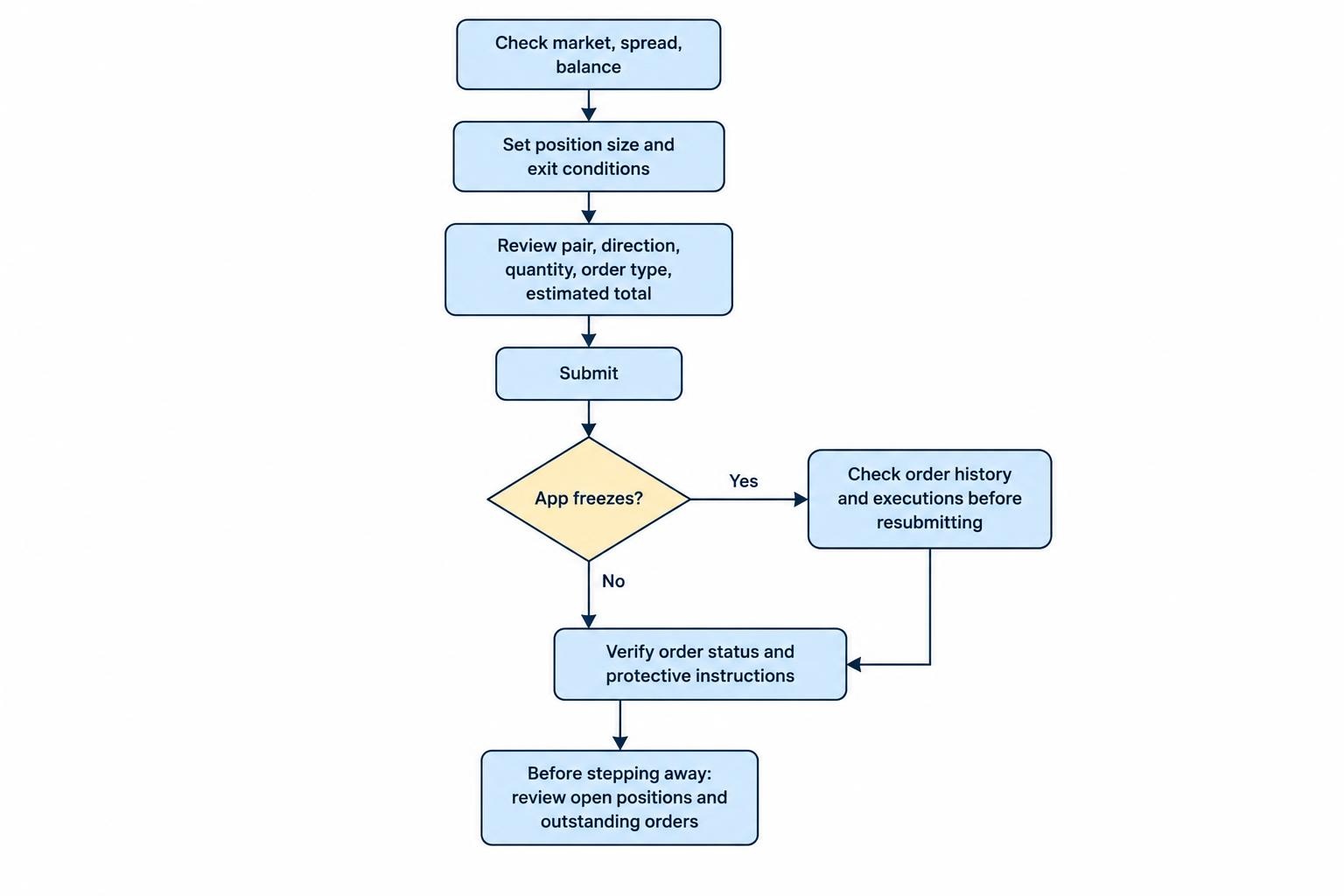
Use the order preview as a checkpoint. Confirm the asset pair, buy or sell direction, quantity, order type and estimated total. Review decimal places carefully, particularly when the token price is low or the quantity is large.
A market order prioritises execution at available prices rather than guaranteeing the displayed price. A limit order sets the highest purchase price or lowest sale price you will accept, but may remain unfilled. A limit order can also fill in parts, leaving a smaller outstanding order than the amount originally submitted.
Protective orders need equal scrutiny. Check what triggers a stop and what order follows that trigger. A stop market order does not guarantee its eventual execution price. A stop limit order can remain unfilled if the market moves beyond its limit. The mobile trading order types guide covers these tradeoffs in more detail.
After submitting, verify the status in the order history. “Submitted,” “open,” “partially filled” and “filled” describe different states. If the app freezes, do not immediately submit the same trade again. Check existing orders and executions first, using another official access route if necessary.
Treat push notifications as prompts to check your account, not proof that an order has executed or a position has closed.
Size Positions for the Loss You Can Accept
Decide your maximum planned loss before choosing the trade size. Starting with the amount you would like to earn reverses the process.
Suppose you allocate $2,000 to speculative trading and choose a planned loss allowance of $20 for one trade. If your intended exit is 5% below entry, a simplified calculation gives a $400 position: $20 divided by 0.05. This is an illustration, not a suggested risk level.
Fees and adverse execution can push the realised loss beyond $20. A disrupted connection or a market that moves through the exit level can widen the difference further. Reduce size to allow room for costs and avoid treating a stop price as an insured payout.
Account for combined exposure too. Several positions can express the same underlying bet on rising crypto prices. Owning five tokens does not automatically provide five independent sources of risk. Use a written account limit alongside individual trade limits; mobile trading risk management covers that wider framework.
Also separate trading funds from money needed for bills or emergencies. If checking a position becomes a condition for getting through dinner, the position may be too large for your circumstances.
Protect the Account and Plan for a Lost Phone
Enable strong account authentication and secure the email account used for recovery. Keep wallet recovery phrases private and outside trading chats, support messages and unsolicited forms. Never hand over recovery material to someone claiming they need it to repair a transaction.
Before funding the account, establish how you would regain access without your current phone. Store recovery information securely, check available session controls and identify the provider’s official account restriction process. Recovery planning belongs before the emergency, not halfway through it.
When transferring crypto, verify the destination address, asset and supported network at both ends. Check whether the receiving service requires a memo or destination tag. Where practical, use a small test transfer before moving a larger amount, accounting for minimums and fees.
The separate guide to mobile trading app security covers device and account protection without mixing those checks into every trading decision.
Keep Records Beyond the App’s Profit Display
An account’s performance chart is not a substitute for transaction records. Retain trade confirmations, fees, deposits, withdrawals and transfers between your own accounts. Record quantities and timestamps, and export history regularly rather than waiting until you close the account.
For US federal tax purposes, selling or exchanging digital assets held as capital assets can produce a reportable capital gain or loss. Exchanging one cryptocurrency for another can matter even when no dollars reach your bank account. The IRS guidance on digital asset reporting sets out the reporting principles and records needed to establish basis.
Keep tax records separate from your trading review. The former documents transactions; the latter should explain why you entered, whether you followed your rules and what the execution actually cost.
Build a Repeatable Mobile Trading Routine
Start with a short watchlist and a written entry condition. Check the market, spread and available balance before opening the order ticket. Set the planned position size and exit conditions before submitting, then verify the resulting order and any protective instructions.
Before stepping away, review outstanding orders as well as open positions. An old buy order can create fresh exposure after you have stopped watching. Decide whether each remaining order still belongs in the plan.
Keep a fallback route available, such as verified browser access, and know where to check service status. Do not assume another device fixes a platform outage, or that repeated taps make an uncertain order safer.
Mobile crypto trading works best when the phone implements decisions you have already considered. Use its convenience to manage access, not to shorten the thinking that should come before a trade.