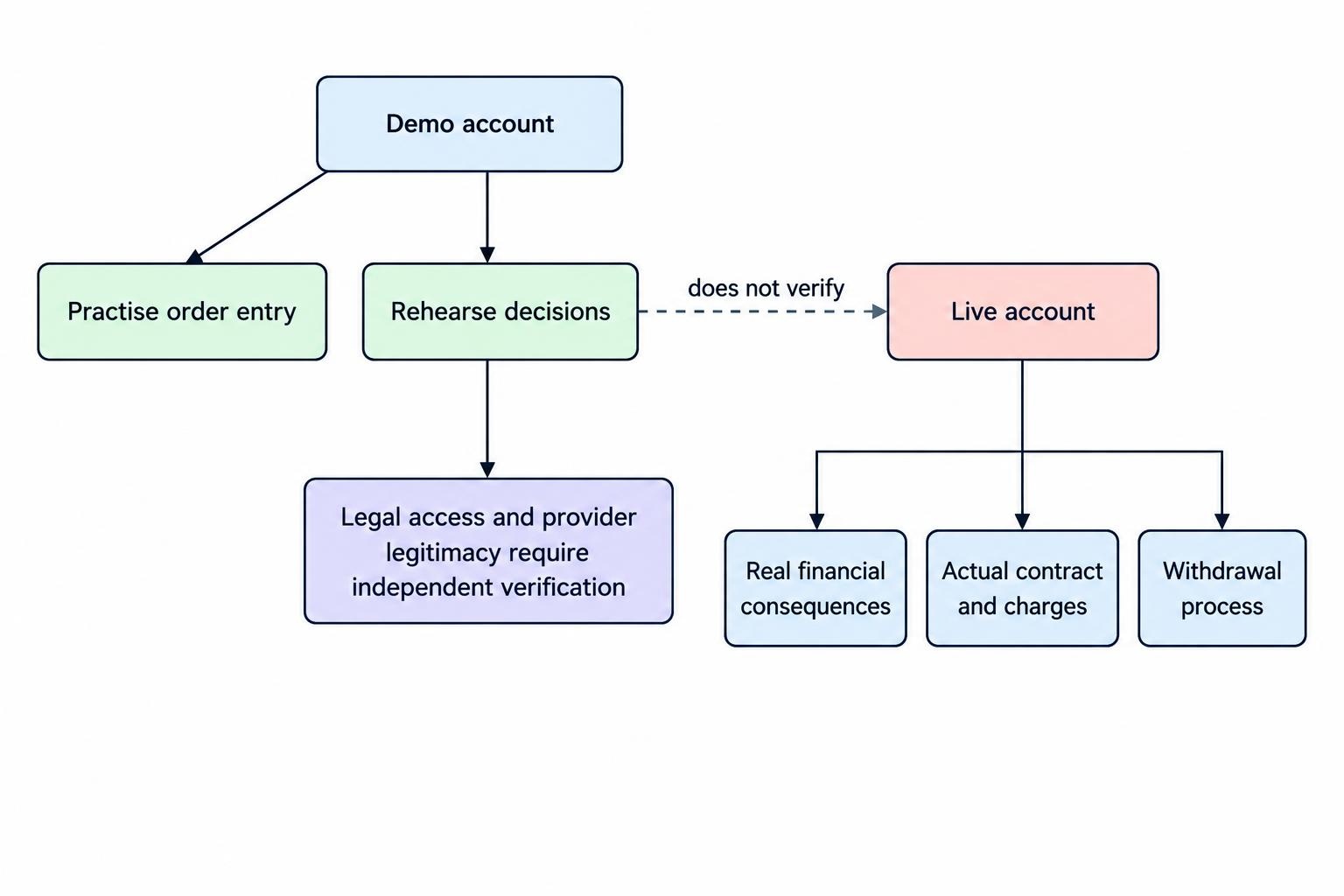
A demo account in a mobile binary options app lets you practise with a virtual balance. A live account puts real money at risk under the provider’s contract, settlement and withdrawal rules. The screens may look almost identical, but the evidence they provide is not.
Demo trading can help you check whether you understand the order ticket, select the intended expiry and follow a repeatable process. It cannot establish that a provider is legitimate, that withdrawals will work or that simulated profits will survive real trading conditions.
The useful question is not “How much did I make in demo?” It is “What did this practice actually test?” Treat the simulator as a rehearsal tool, not a certificate of readiness.
Check Whether Live Trading Is Permitted Before Comparing Accounts
For US readers, binary options are not subject to a blanket prohibition. They can be traded on registered US exchanges, but an offshore app accepting a US address does not establish lawful access. The CFTC’s binary options fraud guidance distinguishes registered exchange trading from unregistered platforms promoted through websites, advertisements and social media.
Before sharing identification or depositing money, establish the legal entity operating the service, its registration status and whether it may offer the proposed product to residents of your jurisdiction. Check the product and venue, not just a licence number displayed in the app. If you cannot verify permission independently, a successful demo does not resolve the problem.
Availability also differs by country. Since April 2, 2019, firms acting in or from the UK have been prohibited from selling, marketing or distributing binary options to retail consumers under the FCA’s permanent retail binary options ban. A demo account does not remove that restriction.
These checks come before performance analysis. There is little value in refining a trading method for a live service you cannot lawfully use.
Demo vs Live: What the Comparison Actually Shows
Do not assume that switching the account label from “practice” to “real” leaves everything else unchanged. Compare the written terms and available settings. Where the provider does not explain how its simulator works, mark that feature as unverified rather than assuming it matches live trading.
| Area | Demo account | Live account |
|---|---|---|
| Balance | Virtual funds; resets may be available. | Deposited money and realised gains or losses. |
| Order handling | Tests the simulated order process. | Depends on the venue’s actual acceptance and execution rules. |
| Payouts and charges | Must be checked against live terms. | The accepted contract and applicable fees determine the result. |
| Trading behaviour | Lets you rehearse decisions without losing deposited funds. | Tests those decisions with real financial consequences. |
| Withdrawals | Cannot demonstrate access to real money. | Subject to the provider’s processes and applicable requirements. |
For checks beyond the simulator, use the broader guide to evaluating mobile binary options apps. Account practice and provider assessment are separate jobs; neither should stand in for the other.
What a Demo Account Is Good For
Learning the Order Ticket Without Paying for Mistakes
Use practice mode to check the full sequence between choosing a contract and receiving confirmation. Can you distinguish the underlying market, direction, stake or contract quantity, expiry and potential return? Can you review those details before submission?
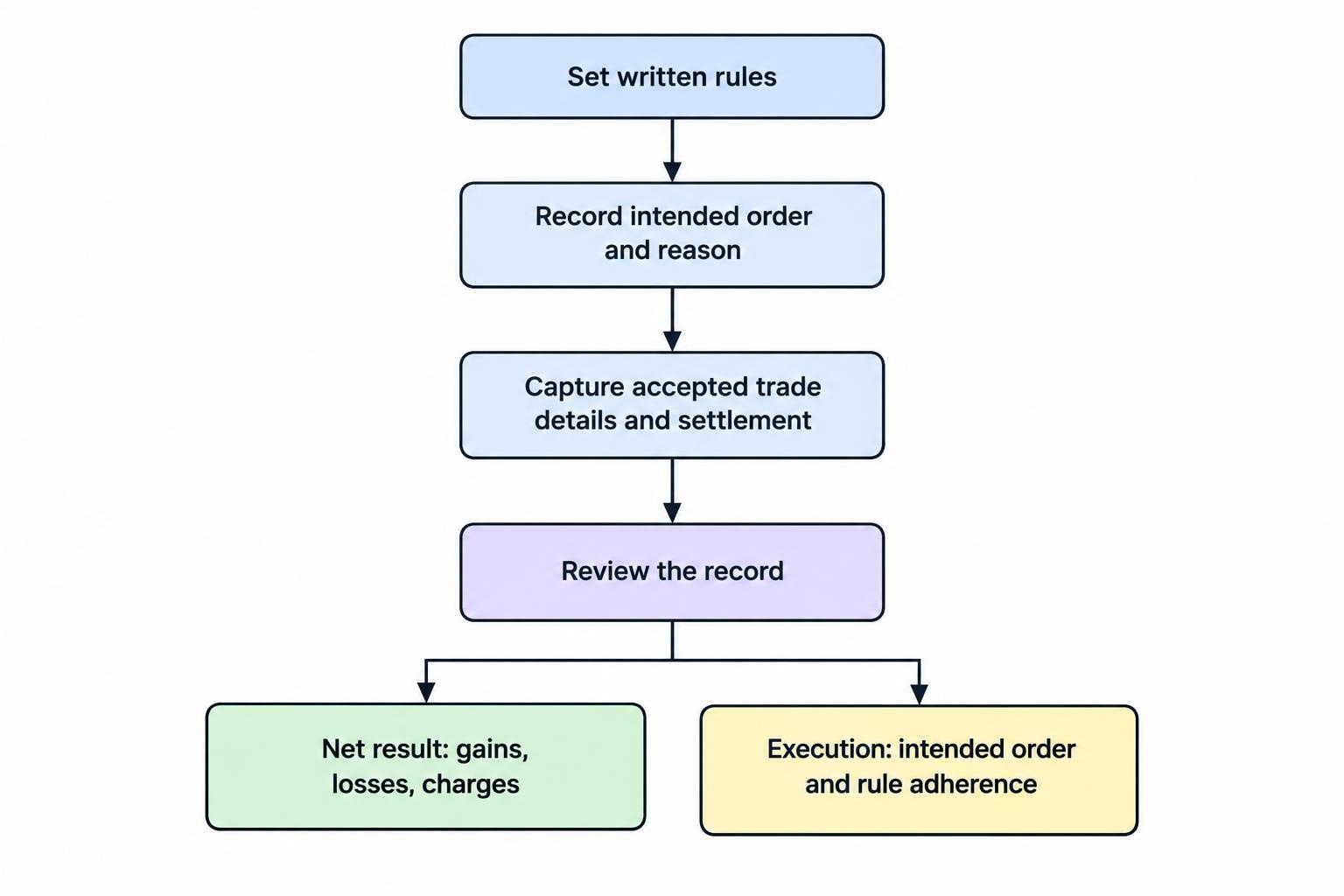
A useful exercise is to write down the intended order before touching the screen. Compare that note with the accepted trade record afterwards. A profitable result does not excuse selecting the wrong expiry. That was an order entry error with a fortunate ending.
Also locate account history, contract details and support information before you need them. The aim is to remove uncertainty about the controls, not to become faster at tapping them.
Checking Whether Your Rules Are Repeatable
A simulator lets you turn vague intentions into observable actions. Replace “trade when the chart looks strong” with conditions you can record before entry: the setup, permitted trading window, contract type and reason to skip a trade.
Keep the same rules throughout a defined practice block. If you change them after every loss, you are testing a moving target. Label a revised method as a new version rather than combining its results with the earlier one.
However, simulation cannot reproduce the full effect of financial risk. Hesitating after a loss or abandoning a method under pressure is part of the gap addressed in the NFA’s notice on hypothetical performance. That notice concerns promotional performance records, but its warning about behaviour without real financial exposure is relevant to demo results too.
Compare Net Results, Not Just Winning Trades
A winning percentage means little without the amount gained on a win and lost on a loss. Demo results should use the contract economics that would actually apply, including any charges. Do not combine results from different payout structures and assume the average win rate tells the whole story.
Consider a hypothetical fixed stake contract where a successful $10 trade returns the $10 stake plus $8 profit. An unsuccessful trade loses the full $10. With no fees, refunds or ties, the break even win rate is:
Break even win rate = stake ÷ (stake + net winning profit)
Here, $10 ÷ $18 equals approximately 55.6%. Winning half the time would lose money. Across 100 trades with 55 wins and 45 losses, winning profits total $440 while losses total $450, leaving a $10 loss before charges.
If the net profit on a win falls to $7, the break even rate rises to approximately 58.8%. This is why a practice record built around an 80% net winning return cannot simply be carried across to contracts offering 70%.
This example does not describe every binary contract. An exchange traded contract bought at a quoted price and settling to a fixed amount needs its own calculation. For the distinctions between returned stake, profit, settlement and expiry, see expiry times and payout displays in binary options apps.
Record the return available when each order is accepted. A headline figure on a promotional screen is not a substitute for the terms of the trade.
Why Profitable Demo Trading Does Not Prove Live Readiness
The Simulation Method May Be Unclear
Ask whether demo and live accounts use the same contracts, price sources, trading hours, order cutoffs and settlement rules. Check how the simulator treats rejected orders, delayed submissions and unavailable prices. If the documentation does not answer those questions, your practice record carries unresolved assumptions.
This does not prove that the demo is dishonest. It means the comparison is incomplete. Avoid both extremes: assuming every simulator is rigged, or assuming a convincing interface must reproduce live trading faithfully.
A Virtual Balance Cannot Test Withdrawals
A growing demo balance says nothing about whether deposited funds can be recovered. Withdrawal refusals, misuse of identity documents and software manipulation feature among the complaints covered by the SEC’s binary options fraud warning. Successful practice does not answer any of those concerns.
Do not deposit money just to investigate a provider whose status or terms you cannot verify. Nor should a small successful withdrawal be treated as proof of future reliability. It establishes only what happened to that request.
Practice Conditions May Be Too Generous
A $50,000 virtual balance with $10 trades does not rehearse the same exposure as a $200 live account with $10 trades. The first risks 0.02% of the balance per trade; the second risks 5%.
Resetting the balance after losses creates another distortion. Preserve losing sessions and track the largest decline from a previous balance peak. The simulator’s reset button is convenient, but real losses do not come with an undo option.
Test the Mobile Workflow, Not Just the Strategy
Use the phone and ordinary conditions in which you expect to make decisions. Check whether you can read the order ticket comfortably, distinguish practice from live mode and locate the accepted order record without rushing. Do not make a tiny display your only record of what happened.
In demo mode, rehearse what you would check after a connection interruption. When service returns, can you establish whether an order was accepted? Where are its identifier and timestamp? Avoid building a habit of tapping submit again simply because the first attempt produced no visible response.
Test interruption handling without placing real money at risk. Lock and reopen the phone, switch away from the app and check whether the displayed account and contract details remain clear. These exercises test usability; they do not guarantee how a live order will be handled.
App store availability is not a regulatory endorsement. The CFTC’s warning about binary options mobile apps makes that distinction explicitly. A polished download page should not carry more weight than an independently verified operator and clear contract terms.
Build a Demo Record You Can Audit
Choose a practice period and rules before starting. You do not need an elaborate spreadsheet, but you do need a record that preserves inconvenient results. Keep any demonstration trades used to learn buttons separate from trades intended to assess a method.
For the assessment record, capture:
- The contract, direction, expiry and stake or purchase price.
- The quoted return, applicable charges and accepted order time.
- The entry reason and whether it met your written rules.
- The settlement result and net change in balance.
- Any entry error, interruption or departure from the plan.
A simple approach to keeping a trading journal on your phone can make this manageable. Write the entry reason before the outcome is known. Otherwise, it becomes too easy to give a winning trade a better explanation than it deserved.
Review performance and execution separately. One question is whether the recorded trades produced a positive net result. Another is whether you selected and submitted the intended orders consistently. A profitable record containing repeated entry mistakes is not evidence of reliable execution.
There is no universal trade count or number of profitable weeks that proves readiness. A longer record gives you more observations, but it cannot repair inaccurate payout assumptions, selective logging or an unverified provider.
Moving to Live Trading Is an Optional Decision
Demo trading does not create an obligation to deposit. Deciding that the product, provider or mobile workflow is unsuitable is a useful outcome, not a failed rehearsal.
If live trading is lawful and the service has been independently verified, assess the smallest permitted exposure against a separate amount you can afford to lose. A small minimum deposit is not necessarily a small trade risk. In the earlier $200 account example, five unsuccessful $10 trades would consume 25% of the starting balance before charges.
Set boundaries before opening a position: the maximum total amount at risk, a stopping point and a rule against adding funds to recover losses. Broader mobile trading risk management should remain separate from whatever virtual balance the app supplies.
Keep demo and live records distinct. Compare order accuracy, contract terms and net results without treating every difference as misconduct or dismissing every difference as nerves. Investigate what can be documented, and stop where the evidence is inadequate.
The right role for demo trading is narrow but useful: learn the controls, rehearse decisions and expose weaknesses without risking a deposited balance. It is not proof of lawful access, provider reliability or future profit. Those questions remain separate, however green the practice account looks.