Managing overnight swing trading positions on mobile starts before you put the phone down. Decide how much exposure to keep, confirm which orders will remain active, check the next event window and plan what happens if you cannot log in. Watching prices from bed is not a substitute for those decisions.
The aim is to hold a trade through ordinary market movement without leaving the account dependent on a notification or a quick reaction. Within a broader mobile swing trading approach, overnight management should be a repeatable review, not an invitation to trade every time the screen lights up.
Decide Whether the Position Still Deserves an Overnight Hold
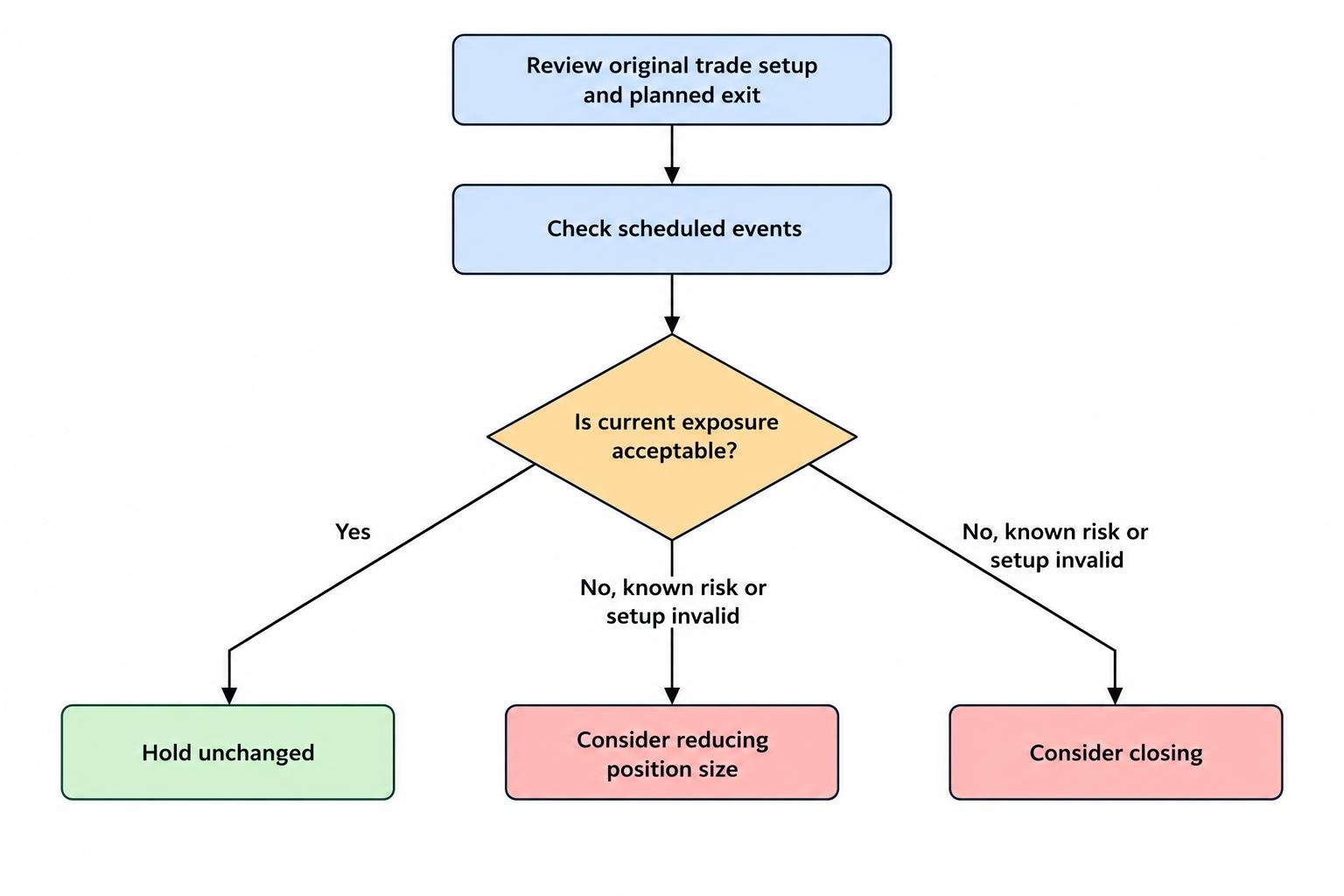
Review the trade against its original reason for entry. Is the setup still valid? Has price reached the planned exit area? Would you accept the current exposure if you were opening the position now? That last question helps separate a deliberate hold from reluctance to realize a loss.
Choose among three actions: hold the position unchanged, reduce it or close it. A smaller position can preserve participation while bringing the possible loss closer to your budget. Closing is reasonable when the trade no longer meets its conditions, or when the next session brings a risk your plan was not designed to carry.
Do not move the exit farther away simply because you will be asleep. That changes the trade rather than manages it. If the original exit leaves too much overnight exposure, review the position size instead.
Check Events Before Checking Another Indicator
Review scheduled announcements between your final check and your next realistic opportunity to act. For a stock, check the company’s investor relations calendar for earnings and other announced events. For currency or index exposure, review relevant economic releases and central bank decisions.
Record the event time with its time zone. “Before the open” is not enough when you are traveling, trading a foreign market or using a phone that has changed its local clock. Also check the next trading session, including holiday arrangements.
Set an event policy in advance. You might avoid holding individual stocks through earnings, or require a smaller position for a scheduled announcement. The policy should reflect the strategy, not the appeal of the latest trade. A calendar check cannot remove surprise news, but it can stop a known event becoming an accidental bet.
Size for a Gap, Not Just the Distance to Your Stop
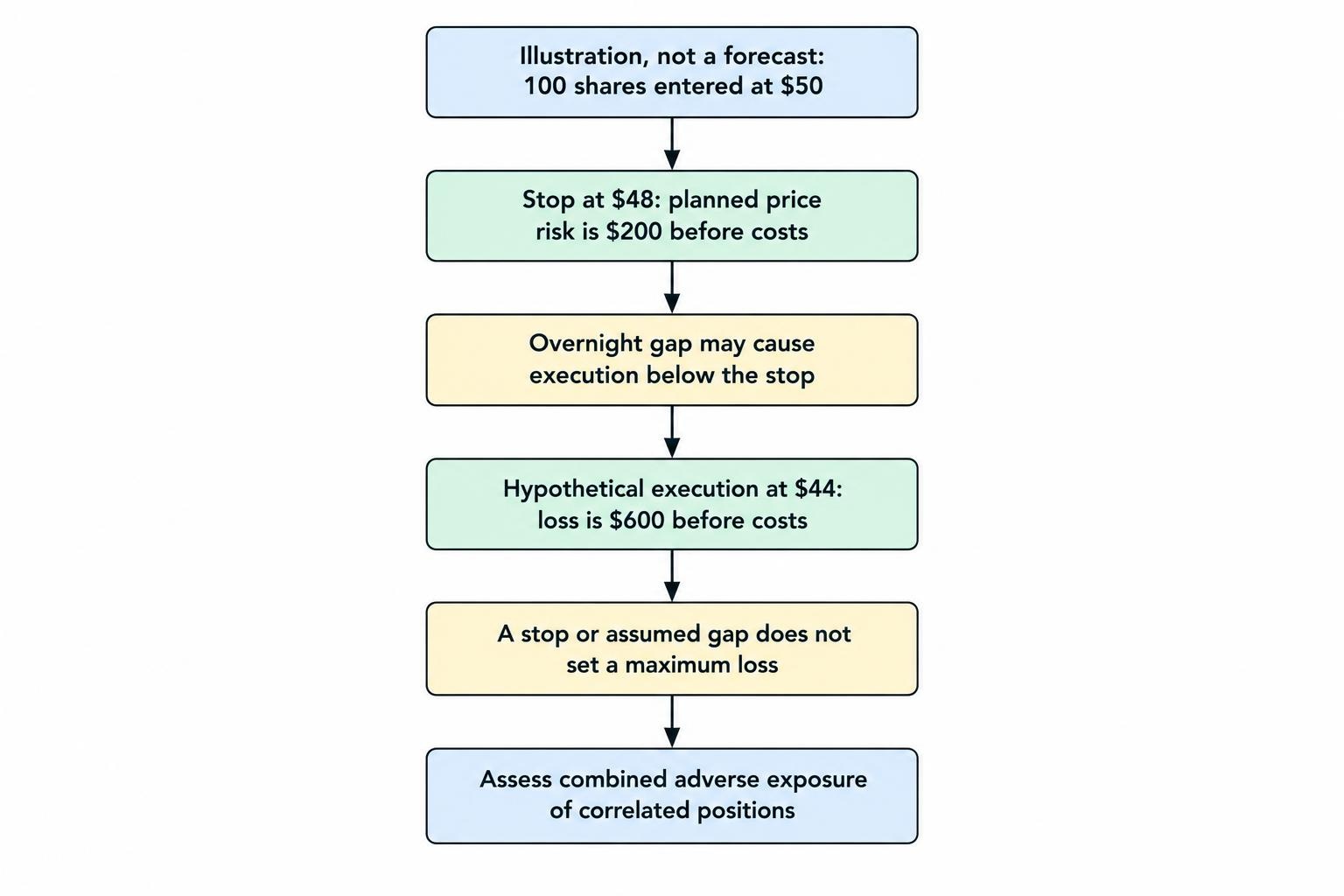
A stop based calculation is a useful starting point, but an overnight review needs an adverse gap scenario too. Treat the stop distance as a planned exit distance, not a promise about the final loss.
Consider a hypothetical purchase of 100 shares at $50 with a stop at $48. The planned price risk is $200 before costs. If the first available execution after an adverse announcement were $44, the loss would instead be $600 before costs. These figures illustrate exposure; they do not predict how far a stock might move.
Then repeat the exercise across the account. Three positions exposed to the same sector or economic event should not automatically receive three independent risk allowances. Ask what the combined loss would be if all moved against you together.
Use position sizing for mobile traders to calculate the starting quantity, then apply an overnight stress check. If the scenario produces an unacceptable account loss, reduce exposure before the market becomes harder to access.
No chosen gap assumption creates a maximum loss. Its purpose is to expose a position that only looks affordable because the calculation assumes an orderly exit. Include estimated charges in the review, and avoid using all available buying power as the measure of what you can safely hold.
Know What Your Overnight Exit Order Actually Does
For stocks, a standard stop order becomes a market order once triggered. Its execution price can differ substantially from the stop price. A stop limit order adds price control, but it may remain unfilled when the market moves past its limit. The SEC investor bulletin on stop and stop limit orders sets out this tradeoff and notes that firms can use different trigger standards.
Choose the order around the risk you intend to manage. If exiting matters more than receiving a minimum price, recognize the execution uncertainty of a stop market order. If you will not sell below a chosen price, recognize that a stop limit order can leave you holding the position.
Neither choice makes an overnight gap harmless. A tighter stop is also not a replacement for smaller size. It changes the trigger level, while leaving the possibility of an adverse execution or an unfilled order.
Verify Duration, Session and Remaining Quantity
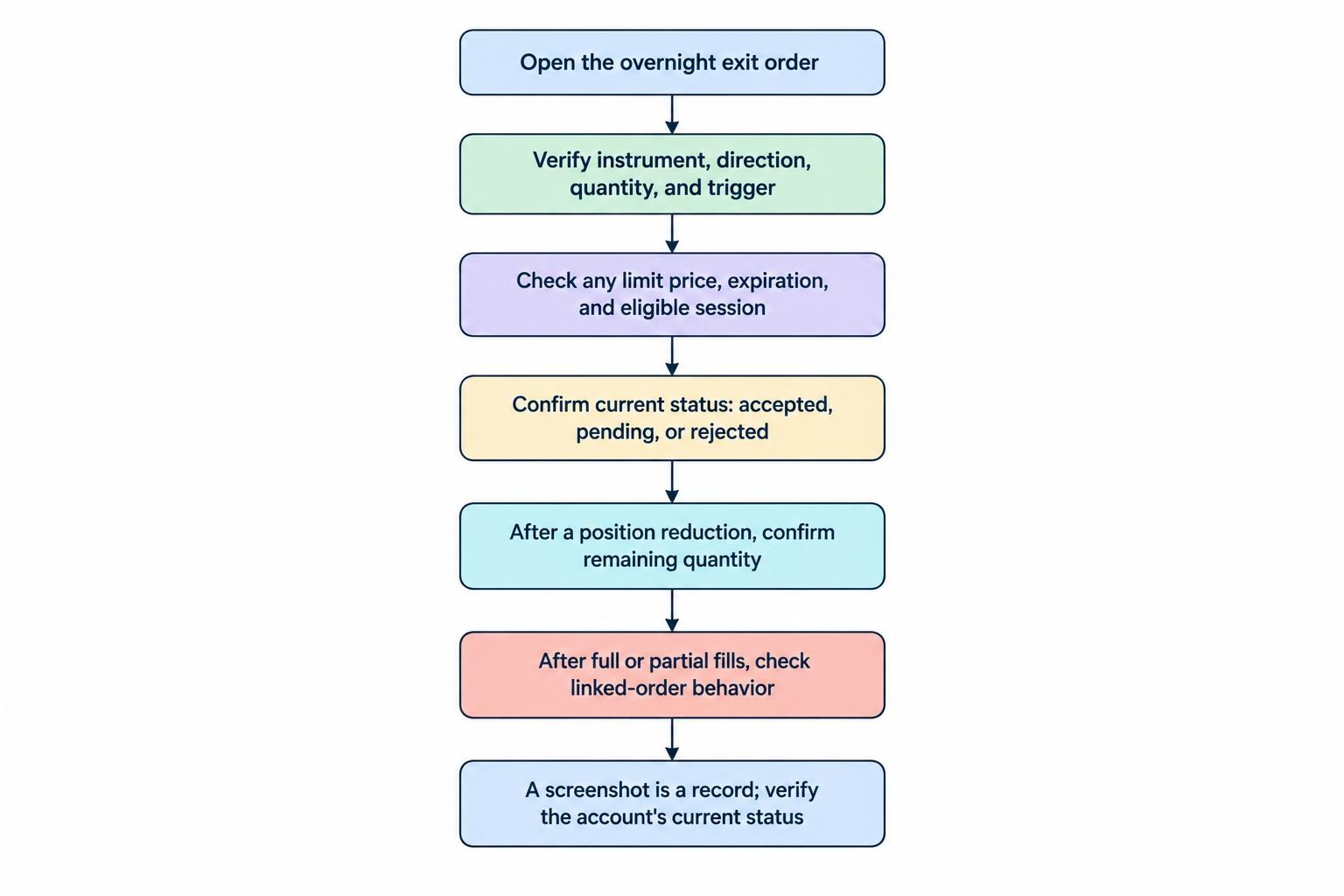
Before leaving the app, inspect the live order details rather than relying on a chart marker. Check the instrument, direction, quantity, trigger, any limit price, expiration and eligible trading session. A duration label alone does not answer every session eligibility question; confirm the broker’s terms for that order.
If you reduced the position manually, check the remaining exit quantities. If you changed an order, confirm the replacement was accepted rather than left pending or rejected. For linked exits, verify what happens to the other order after a full or partial fill.
Save the order reference if useful, but treat a screenshot as a record, not proof that the order remains live. The account’s current order status is what you need to verify.
Separate Market Access From the Ability to Exit Well
An app displaying a price does not settle whether you can trade that instrument, in that account, during that session. Before an overnight hold, establish which sessions you can access and which order types work there.
For US stocks, extended hours can bring lower liquidity, wider spreads, higher volatility and partial or failed executions. Prices can also differ between trading systems. These risks appear in FINRA’s extended hours trading risk disclosure. Access outside the regular session is useful, but it is not equivalent to an assured exit at the displayed price.
| Exposure | What to verify | Decision it informs |
|---|---|---|
| Stocks and ETFs | Session access, order eligibility, quote timestamp and scheduled issuer events | Whether the planned exit can operate during your absence |
| Currency products | Trading breaks, rollover terms, financing and the broker’s trigger rules | Whether carrying costs and execution conditions fit the trade |
| Futures | Contract sessions, margin requirements, expiry and price limit rules | Whether the account and exit plan can support the hold |
| Cryptocurrency | Venue availability, maintenance notices and order handling | Whether continuous access is an assumption or a checked condition |
For futures, price limits can result in a temporary halt, trading within a limit condition or an end to trading for the session, depending on the product. Check the relevant contract through CME Group’s product price limit information. A market being scheduled to trade does not mean every exit remains executable.
Review Margin and Carrying Costs Before Stepping Away
Read the account figures as a risk check, not just a buying power check. Review current equity, the applicable maintenance requirement and the amount of room between them. Then consider how an adverse move across several holdings would affect that room.
For US securities margin accounts, a firm can liquidate assets without contacting the customer first and can raise its house maintenance requirements without advance written notice. These risks are included in FINRA’s required margin disclosure statement. Do not make an overnight plan that depends on receiving a call and transferring money before liquidation.
For any financed product, check the actual carrying terms for the instrument, position direction and holding period. Review borrowing charges where relevant, along with the treatment of weekends and holidays. Use the account agreement and current rate information rather than carrying an old estimate into a new trade.
A position can still meet its chart conditions while no longer meeting its cost or margin conditions. Those are valid reasons to reduce or exit it.
Use Mobile Alerts to Support the Plan
Give each overnight alert a job. An alert near a review level might prompt you to inspect the position; an event reminder might prompt a planned reduction before an announcement. Avoid filling the phone with alerts that have no agreed response.
Keep the detailed setup separate from the trading decision. The guide to setting price alerts for mobile swing trading covers that workflow. Here, the test is simpler: can the trade remain within acceptable risk if the alert arrives late, stays silent or goes unnoticed?
Test your notification arrangement before relying on it. Check app permissions, sound settings and any sleep or focus schedule. Use an appropriate test alert where available, rather than assuming an alert saved in the app will interrupt your phone as intended.
Also decide when you will not respond. A multi day trade should not turn into a series of improvised entries and exits because you checked it during the night. If safe management requires constant attention, reconsider whether the size and instrument fit an overnight mobile workflow.
Prepare for a Connection or Login Failure
Before stepping away, know your alternative route into the account. Keep the official support number and account identification requirements accessible without depending entirely on the trading app. Check whether a browser platform or another approved channel is available, and learn its restrictions before an urgent situation.
If an order submission produces an uncertain result, do not immediately send the same order again. Establish whether the first instruction was accepted, filled, rejected or is still pending. Otherwise, an attempted fix can create duplicate exposure.
Use the procedure for a trading app disconnecting with open positions as your fallback plan. The overnight decision should already allow for a period without access. A backup connection helps with access; it cannot guarantee an execution or reverse a gap.
Leave a Short Handover Note for the Morning
Write a compact note before your final check: current quantity, accepted exit orders, next event, reason for holding and the condition that would invalidate the trade. Include your next planned review time. This gives the morning review a starting point other than the profit and loss figure.
When you return, reconcile the account before placing another order. Confirm the live quantity, inspect any fills, check remaining exits and review margin. Distinguish an actual execution from an alert, a quote update or a chart touch.
For a favorable gap, apply the profit taking or trailing rule you chose beforehand. For an adverse gap, assess the remaining position against the plan rather than waiting automatically for the entry price to return. Avoid enlarging the trade just to make the average entry look better.
Record any difference between the planned exit and the actual fill, plus carrying costs and access problems. Over repeated trades, those records can help you judge whether the overnight approach fits the instruments and account you use.
The final standard is practical: the position should remain acceptable while you are asleep, offline or dealing with something else. If it needs an immediate reaction to stay tolerable, reduce it, close it or change the plan before putting the phone down.